Brain samples are separated using an Agilent 1290 Infinity II liquid chromatography system.
There are several considerations in running larger sets of samples without sensitivity loss. Solutions to these problems that we implement in our laboratory include:
Reducing extra-column volume ensures run times are reduced. The plumbing requirements for a single column setup is listed below.
Liquid chromatography tubing details for single column setup
| Location | Part description | Agilent part number |
| binary pump mixer | V35 JetWeaver mixer | G7120-68135 |
| tubing from pump to autosampler | 0.17 mm ID, 600mm stainless steel tubing | G1312-67305 |
| needle | needle | G4226-87201 |
| needle seat | High pressure seat assembly 0.075 mm | G4267-87020 |
| tubing to analytical head | Capillary SST 0.12x50mm long Socket | 5500-1243 |
| sample loop assembly | 20ul loop assembly | G4226-60310 |
| tubing to column compartment | Quick Turn capillary stainless steel 0.075 x 105 mm | 5500-1198 |
| in-line filter (including frit) | InfinityLab quick change inline filter (0.2 µm) | 5067-1603 |
| heat exchanger | InfinityLab Quick-Connect heat exchanger, ultralow dispersion. 0.075 mm id, 1 µL | G7116-60021 |
| connection to column | InfinityLab Capillary ST 0.075 mm x 105 mm with Quick Connect fitting | 5500-1174 |
| connection from column | Quick Turn LC Fitting | 5067-5966 |
| peek tubing to MS | Capillary ST 0.075 mm x 500 mm, long socket | 5500-1205 |
The liquid chromatography system is coupled to an Agilent 6490/6495C triple quadrupole LC/MS with an Agilent Jet Stream technology ionization source. Mass spectrometer and source parameters are shown below. Agilent Jet Stream source parameters were optimized using Agilent Source Optimizer software to balance sensitivity across all classes. A cycle time of 900 ms was chosen to maintain an adequate number of points across the peak for reliable quantitation.
MS instrument parameters
| Parameter | Agilent 6495C Triple Quadrupole Mass Spectrometer |
|---|---|
| Ion source | Agilent Jet Stream |
| Polarity | Positive and Negative Switching |
| Gas Temperature | 200 °C |
| Drying Gas (Nitrogen) | 17 L/min |
| Nebulizer Gas | 20 psi |
| Sheath Gas | 280 °C |
| Sheath Gas Flow | 10 L/min |
| Capillary Voltage | 3,500 V (+), -2,500 V (-) |
| Nozzle Voltage | 1,000 V (+), -1,000 V (-) |
| iFunnel High/low pressure RF | 210/160 V (+), 200/160 V (-) |
| Scan Type | Dynamic MRM (DMRM) |
| Q1/Q2 Resolution | Unit (0.7 amu) |
| Delta EMV | 100 V (+), 0 V (-) |
| Cell Acceleration Voltage | 4-5 V |
| Cycle Time | 900 ms |
| Time Filter Width | 0.07 min |
| Total number of MRMs | 938 (positive: 925, negative: 13) |
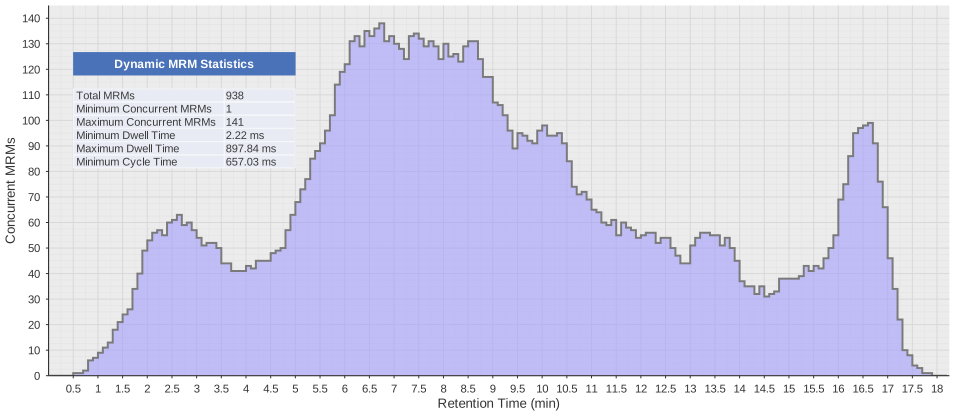
A critical aspect of this methodology is the use of dynamic multiple reaction monitoring (dMRM) within the mass spectrometer. For the instrument to measure the large number of lipid species in the extended lipidome, the specific retention time window within which each compound elutes must be defined, such that the instrument only scans for a given lipid species at specific points across the total sample run time. This retention time window varies for different MRMs and is dependent largely on differences in peak width. This approach improves the instrument duty cycle and extends the average dwell time per compound, as seen below.

 Home
 PheWeb
 Methods
 Atlas
 About
 Contact